

ENX is engineered to meet the demands of a popular operating profile, the one-week Mediterranean charter. 60 MWh installed across three dedicated battery spaces, provides a range of 625 nautical miles
Lateral Naval Architects has revealed ENX, a 70-metre platform which is the output of the company's 2026 Lateral Engineering Innovation Project, and the answer to the critical question:
How far can the progression towards electrification realistically be taken while retaining the freedom, capability and experience expected of a yacht?
Starting with how yachts are used
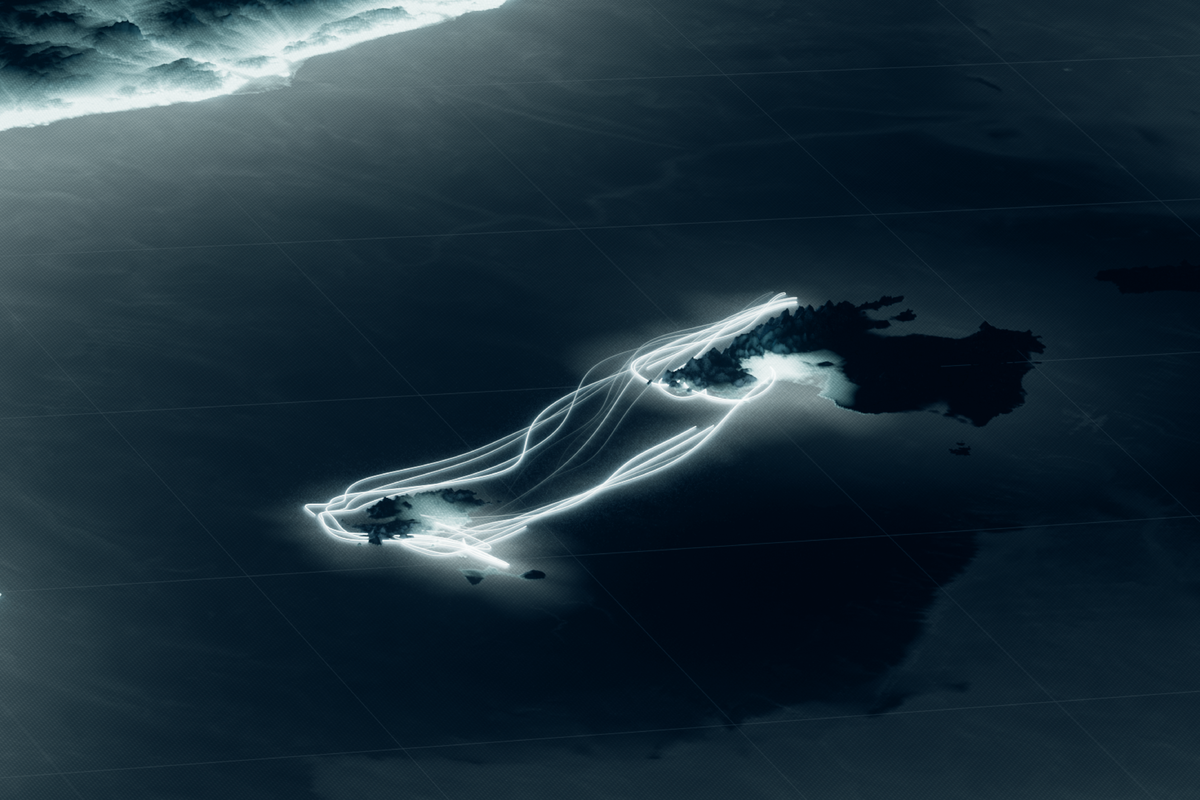
To find the solution, Lateral first had to understand the problem. AIS records for the Mediterranean charter fleet were analysed against operational experience on board: where the yachts went, at what speed, for how long, and what that movement costs in energy. 70-metre yachts are a key segment of the superyacht market and this size of yacht was selected for analysis.
The analysis indicates that a highly efficient 70-metre superyacht of around 1,700 GT would require approximately 37 to 50 MWh to meet propulsion and hotel load demand over a one-week charter on typical Mediterranean cruising itineraries, covering around 350 nautical miles.
Five representative routes were identified, all possible within an energy demand of 50 MWh:
Balearic Islands, Mallorca to Ibiza to Formentera. 7 days, 380nm, 37 MWh
French and Italian Riviera. 10 days, 257nm, 41 MWh
Turquoise Coast, Turkey. 6.5 days, 365nm, 44 MWh
Cyclades, Greek Islands. 9 days, 432nm, 47 MWh
Corsica, Sardinia and Italy. 9 days, 371nm, 50 MWh
The demand was found rather than assumed, and it set the size of everything that followed.
Sizing the energy storage
To meet that observed demand while accounting for end-of-life degradation and the required battery reserve, total installed capacity for ENX is approximately 60 MWh. That represents around 300 tonnes of battery mass, using a projected battery technology suitable for use within the next five years, and occupies a volume comparable to two-thirds of a basketball court.
The projection is not speculative. Lateral assesses marine battery products against an internal technology readiness scale, considering operating profile, discharge rates, installation restrictions, price and commercial availability alongside energy density. ENX applies that method to predict available performance in five years, which returns an approximate 20 per cent increase in energy density over today's commercially available marine batteries.
A yacht built around its batteries
Batteries on superyachts have traditionally been accommodated within residual technical spaces: areas with insufficient headroom, or locations otherwise unsuitable for primary equipment. For ENX that approach has been reconsidered, with the yacht built around the batteries as a primary consideration.
Capacity is distributed across three dedicated battery rooms, forward, midship and aft, positioned to maximise volumetric efficiency while maintaining safe access, maintainability and integration with the wider vessel arrangement. Battery mass is managed to hold correct trim, comfort and stability.
The platform is built on an efficient Lateral Series A hull form, optimised for a relatively slow speed to suit typical guest operations. That is combined with advanced HVAC, thermal management and automation for careful and deliberate load management, and with space-efficient, high-power-density variable-speed generators on a DC grid distribution system.
Three operating modes
Guest operation is the typical condition throughout the charter. Silent running, zero local emissions, with battery power alone meeting propulsion and hotel load demand.
Shore recharge is standard turnaround charging between charters. With predicted Mediterranean infrastructure, charging from 20 to 100 per cent will typically require 10 to 48 hours.
Long-range transit uses the Energy Extender, an onboard charging solution that enables extended passages between charters and preserves the Atlantic crossing capability expected of a yacht at this size. Extended range is 4,500 nautical miles.
Safety
Large-scale energy storage introduces requirements that a conventional machinery arrangement does not. ENX follows class society regulation throughout: class type approved batteries with a battery management system that isolates any single cell entering thermal runaway; dedicated Ex-rated ventilation for hazardous gas removal; automatic shutdown on abnormal temperature or charging conditions; IP-rated protection against leakage or water ingress; automated high-capacity watermist drenching inside the battery rooms; A60 fire-rated compartmentation with no flammable material permitted in battery spaces; and class approval of the complete ship's battery system including HAZID and FMEA activities.
Charging and carbon
Shore power charging allows lower carbon energy to be drawn directly from the grid. Charging via the onboard generator carries an intensity of 660 to 700 gCO2eq/kWh, significantly higher than most Mediterranean shore power supplies, which vary by national generating mix from 30 to 850 gCO2eq/kWh.
Main particulars
Length overall: 70.0 m
Length waterline: 70.0 m
Beam (moulded): 12.0 m
Draught (full load): 3.5 m
Gross tonnage: 1,700
Notation: REG Yacht Code Part A
Propulsion architecture: All electric architecture
Energy storage system: 60.0 MWh
Top speed: 14.0 knots
Range speed: 11.0 knots
Electric range: 625 nm
Extended range: 4,500 nm